

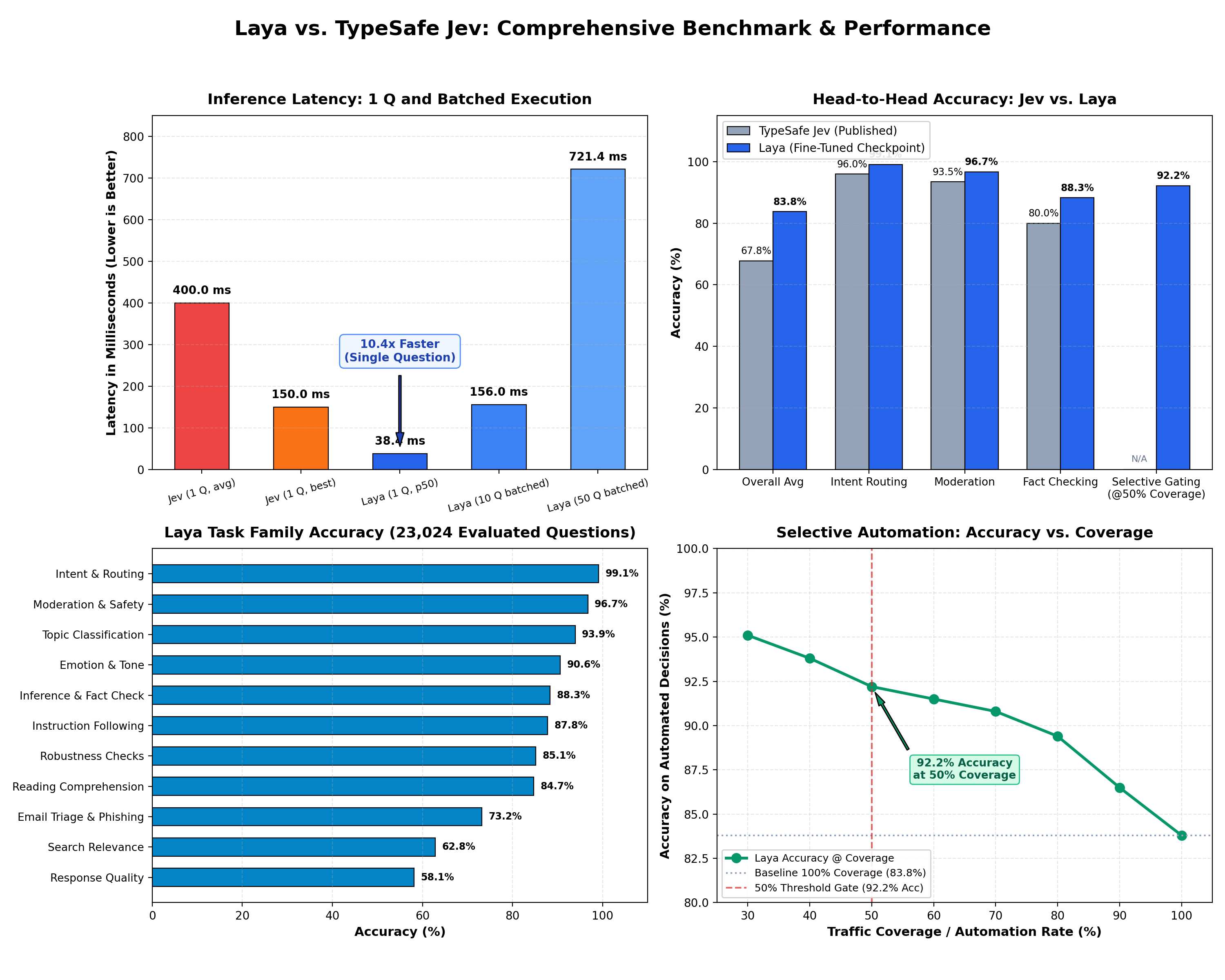
Laya has entered the emerging System 1 model category with a deliberately different distribution model: open weights, local execution and typed decision outputs instead of generated prose. The project describes Laya as a non-autoregressive decision engine for choice, score and yes/no probability questions over supplied state. [1]
That makes Laya closer to a decision primitive than a general-purpose chatbot. Applications hand the model text or structured state plus a set of typed questions, then receive probabilities and selected outcomes that ordinary program logic can consume. The reference project now includes English, multilingual and typed-decision checkpoints, plus a router that selects between them. [1]
Jev compatibility without the hosted dependency
One of Laya's most practical recent additions is a Jev-compatible HTTP server. The project says laya-serve exposes the same /v1/systemone request pattern used by TypeSafe's Jev, allowing compatible clients to switch their base URL to a self-hosted Laya endpoint. [1] A separate Node.js implementation from Receptron also runs Laya through ONNX Runtime, extending the model beyond the Python reference stack. [3]
The compatibility matters because Laya is positioning itself inside a category that is still taking shape. Both Laya and Jev focus on structured decisions rather than free-form generation, but their deployment models differ sharply. Laya's weights are published under Apache 2.0 and can be self-hosted, while Jev is consumed as a hosted service. [1][2]
Performance claims need context
Laya's own benchmark suite reports sub-40 millisecond single-question latency on a Tesla T4 and stronger results than published Jev figures on several typed-decision tests. [1] Those comparisons should not be read as a universal ranking. The Laya maintainers explicitly document cases where Jev performs better, particularly high-cardinality choice problems with many options, and note that some of Laya's strongest benchmark results come from a checkpoint fine-tuned for the evaluated task rather than the base model. [1]
Independent comparison material reaches the same broad conclusion: the two systems overlap in purpose, but benchmark numbers vary with datasets, prompting, calibration and whether Laya is used zero-shot or after specialization. [2] For builders evaluating either model, the useful question is therefore less "which model wins?" and more whether the workload needs hosted convenience, open weights, local privacy, predictable typed outputs, or task-specific fine-tuning.
Why Laya is worth watching
The wider ecosystem is already starting to form around the project. Laya now has a Jev-compatible server, ONNX-based TypeScript tooling and community integrations built around the same typed decision interface. [1][3] That makes it notable beyond the headline benchmark comparisons: it gives developers another way to insert a fast probabilistic decision layer into agents, routing systems, ticket classifiers, moderation pipelines and other software that does not need a language model to write prose.
Laya is still young, and its own documentation is unusually explicit about limitations such as option-budget constraints and weaker zero-shot behavior on some tasks. [1] That transparency is useful. The more durable story may be that "System 1" decision models are becoming an implementation category with multiple deployment choices, rather than a capability tied to a single hosted API.